

 By Rohit More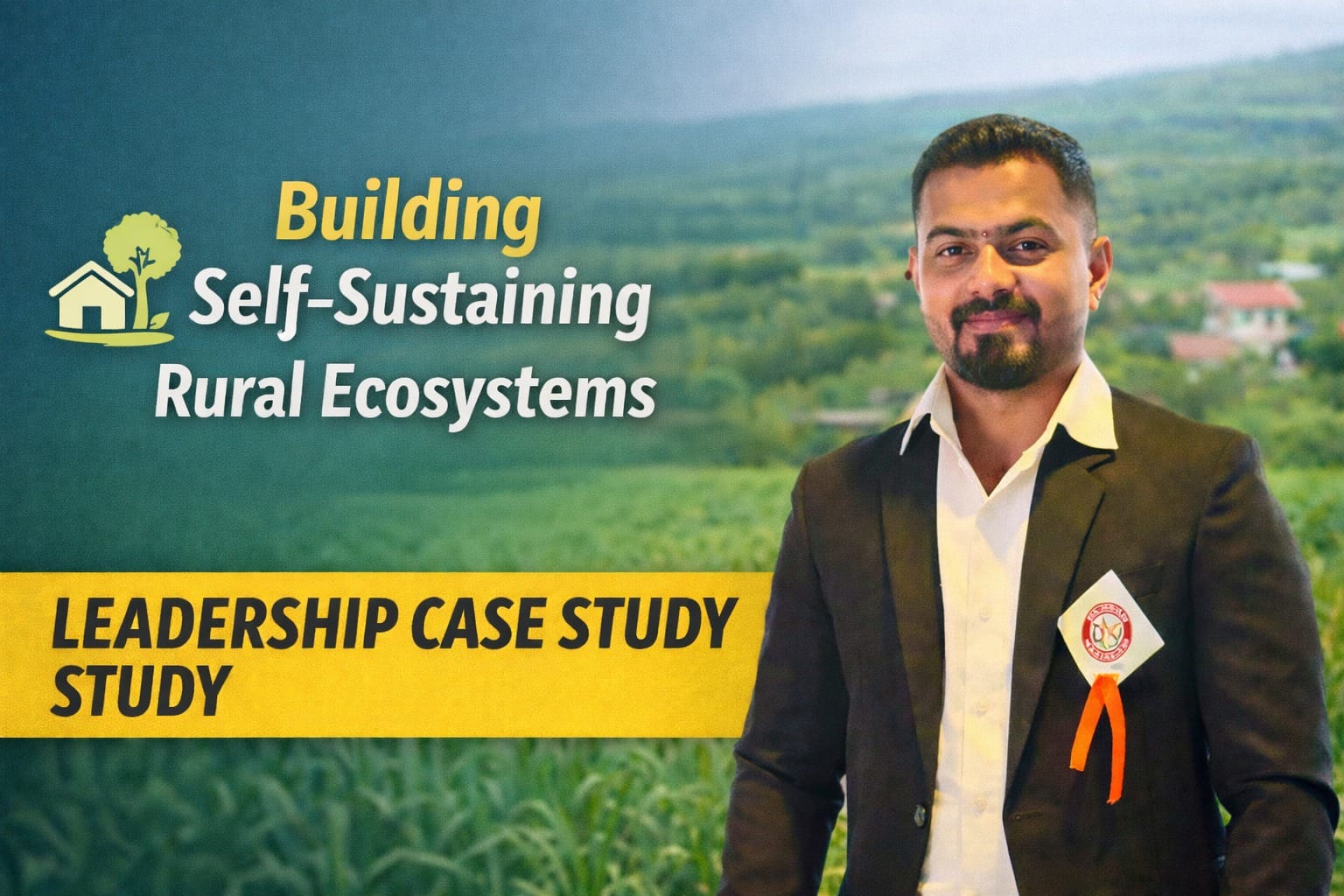
Shruti Patil Shirala: A Case Study on Leadership Building Self-Sustaining Rural Ecosystems in Maharashtra
Rural development in India is often discussed in terms of government schemes, CSR initiatives, or NGO-led interventions. However, true transformation happens when leadership emerges from within the community and builds systems that sustain themselves over time. This is exactly what Shruti Patil Shirala highlights in her case study on Shriram Nangre-Patil, a social entrepreneur and activist from Shirala, Sangli (Maharashtra), who has created a powerful rural ecosystem through strategic business leadership and social impact.
This blog explores the key insights of the case study and explains how leadership, entrepreneurship, and stakeholder-driven thinking can create long-term rural progress.
Introduction: Leadership Beyond Traditional CSR
In today’s corporate world, social responsibility is often treated as an additional activity after profit-making. But Shriram Nangre-Patil’s approach is completely different. His leadership model integrates social responsibility into the core of business operations rather than keeping it separate.
According to Shruti Patil Shirala, his work represents a modern example of stakeholder capitalism, where success is measured not only by financial profit but also by social impact, lives improved, and opportunities created for the community.
Who is Shriram Nangre-Patil?
Shriram Nangre-Patil is based in 32 Shirala, Sangli district of Maharashtra. With strong academic qualifications including B.Sc. in Sugar Technology and an MBA in HR and Marketing, he has successfully combined professional business knowledge with deep-rooted social activism.
He is associated with multiple initiatives such as:
- Business Minds Consultancy Pvt. Ltd.
- Shriram Foundation
- Shriram Abhyasika Shirala (Study Centre)
His work is built around a vision of creating an interconnected rural economy that does not depend on a single income source or limited opportunities.
The “100 from 100” Diversification Model
One of the most unique concepts in this case study is Shriram’s business philosophy:
“Earning ₹100 from one business is powerful, but earning ₹100 from 100 businesses is sustainable.”
This idea reflects a multi-stream diversification strategy. Instead of depending on one business, he intentionally created multiple small and medium ventures. This ensures that if one business fails, the overall mission of rural development continues without disruption.
Why This Model Matters
Rural businesses often face unpredictable challenges such as:
- changing government policies
- environmental regulations
- economic uncertainty
- market instability
By creating multiple income streams, Shriram built a system that can survive external shocks and remain stable over time.
Healthcare Support: Ambulance Service as a Lifeline
A major highlight of this case study is Shriram’s ambulance service, which operates efficiently within a 15-kilometre radius. In rural regions, emergency healthcare is often delayed due to lack of transport and resources.
Shriram treated this as a priority responsibility, not as a side project. His system ensures quick response, creating a safety net for villagers during emergencies.
For him, the true “profit” is measured in lives saved, not just money earned.
Education Development Through Shriram Abhyasika
Education is one of the strongest pillars of rural development, and Shriram identified a major issue: students lacked a proper environment to study for competitive exams.
To solve this, he established Shriram Abhyasika, a monitored study centre that provides a disciplined learning atmosphere.
Real Outcomes
Within just the first year of establishment, more than 10 students secured government jobs, proving the effectiveness of this initiative.
This is a strong example of leadership focused on human capital development, where the goal is not short-term charity but long-term empowerment.
Digital Governance and Transparency in Rural Management
Another major leadership element described in the case study is Shriram’s use of technology.
He introduced:
- CCTV monitoring
- smartphone-based tracking
- transparent staff management systems
This is important because rural businesses are often assumed to lack professional governance structures. His leadership challenges that mindset and proves that rural enterprises can operate with the same transparency and efficiency as urban businesses.
This also helps build community trust, which becomes the most valuable form of capital in rural areas.
Business Ethics: Trust Over Gamble
Shriram strongly challenges the belief that “business is a gamble.” Instead, he believes business is about solving people’s problems and earning their trust.
His leadership style focuses on:
- ethical operations
- community trust-building
- long-term reputation
- people-first strategy
This ethical approach has helped him become not just a businessman, but a respected community leader.
Entrepreneurship Mentorship: Creating Job Creators
Perhaps the most powerful contribution discussed by Shruti Patil Shirala is Shriram’s role in building an entrepreneurial movement.
Through Business Minds Consultancy, he has mentored and supported over 630 entrepreneurs.
This has created a massive shift in rural mindset:
From Job Seekers to Job Creators
Instead of waiting for government jobs or city employment, young people are now learning how to start their own businesses.
This is the foundation of a self-sustaining rural economy, because when entrepreneurship grows, local employment also grows.
Social Franchising: A Zero-Profit Leadership Model
One of the most inspiring concepts in this case study is his social franchising model.
He created three tea franchises and takes zero profit from them.
The purpose is simple:
to help local families become financially independent.
Unlike traditional franchising models that are purely profit-driven, this system is designed for empowerment and sustainable income generation.
This is stakeholder capitalism in its purest form—where business is used as a tool for social stability.
Politics as the “Weather” of Business
Shriram’s philosophy on politics is both practical and unique. He believes politics is not separate from business.
He calls politics the “weather” of business, meaning:
- fuel prices
- regulations
- environmental laws
- economic decisions
are all shaped by political systems.
Just like farmers watch the weather before planning crops, entrepreneurs must understand political environments before planning growth.
He also supports development-first politics and respects leaders like Yashwantrao Chavan and Vasantdada Patil, who focused on building dams, factories, and infrastructure for public welfare.
Leadership Lessons from the Case Study
This case study offers strong leadership lessons for students, entrepreneurs, and policymakers:
1. Diversification Builds Stability
Multiple business streams protect long-term impact.
2. Social Responsibility Must Be Core
Real leadership integrates welfare into business operations.
3. Education is the Strongest Investment
Human capital development creates future leaders.
4. Governance Creates Trust
Transparency through digital systems improves credibility.
5. True Leadership Creates Leaders
A leader’s legacy is not measured by business size but by the number of independent individuals they empower.
Conclusion: A Blueprint for Rural Development
The case study by Shruti Patil Shirala proves that rural transformation is possible when leadership combines entrepreneurship, ethics, governance, and community welfare.
Shriram Nangre-Patil’s model is not limited to one business or one initiative—it is a full ecosystem approach. From healthcare and education to entrepreneurship mentoring and social franchising, he has built systems that ensure rural development remains sustainable and scalable.
Ultimately, this leadership model is a blueprint for India’s future—where villages grow not through dependency, but through empowerment, self-reliance, and locally driven economic ecosystems.
Case Study: A case study on the role of leadership in building self-sustaining rural ecosystems
Case Subject: Shriram Nangre-Patil
Authors:
- Dr. Pratibha Jagtap
pratibha.jagtap@ritindia.edu - Ms. Shruti Mansing Patil
spatil0578@gmail.com
Sharda University Agra in association with Brokenshire College, Philippines: International Conference on Innovative and Sustainable Practices in Redefining Economy 2K26
The Power of Our District PR Ecosystem
We are not just a media agency—we are building an entire district-level digital infrastructure with:
Shruti Patil Shirala,Shruti Patil Shirala,Shruti Patil Shirala,Shruti Patil Shirala,Shruti Patil Shirala,Shruti Patil Shirala,Shruti Patil Shirala